Healthcare robots are already built around specific jobs: moving supplies, guiding rehabilitation exercises, assisting surgery, or helping staff speak with patients from a distance. The useful question is not whether robots will change healthcare, but which task they can do safely and where a person still needs to take over.
- Robots can move items, support treatment, or extend remote access to care.
- Sensors and software matter as much as the robot’s body.
- Results depend on the ward, task, staff, and safety rules.
The work robots can handle
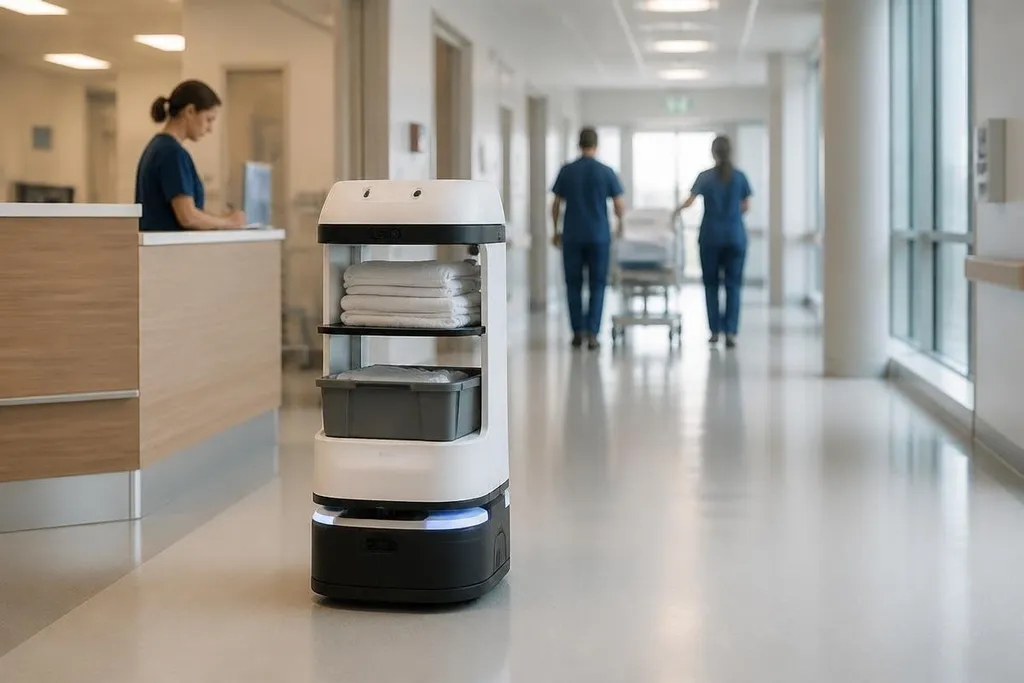
A hospital robot may carry medicine, linens, meals, or waste through set routes. A mobile robot uses cameras, LiDAR, or other sensors to map nearby objects and avoid people.
That can reduce walking for staff, but only when doors, lifts, corridors, and drop-off points work with the robot.
Rehabilitation systems work in a different way. A robotic leg brace can guide a patient through repeated movement while sensors record joint angle or force. The machine can keep each exercise within a set range, while a therapist decides whether that range suits the patient.
Surgical robots also depend on a human operator. The robot’s arms hold instruments, and the surgeon controls the movement from a console. This setup can help with fine hand motion and tool placement, but it doesn’t remove the need for training, planning, or direct clinical judgment.
Why the setting matters
A robot that works in a quiet test room may struggle in a hospital corridor. Staff move beds, visitors stop in doorways, alarms sound, and equipment can sit outside its mapped route. Each change affects how the robot senses the space and chooses its next move.
That makes deployment a work-design problem as much as a hardware purchase. A hospital needs a clear handoff point, a person who responds when the robot stops, and a way to report faults. If a delivery robot reaches the ward but staff still carry every item by hand, the system has added another step.
A ward manager needs evidence from the robot’s working setting, not a short demo. Robot 24 can connect named healthcare machines with their tasks, sites, and reported limits, so you can judge whether the proposed handoff fits daily care. That question leads straight to safety, where a stopped robot still needs a person who knows what to do.
Safety comes before speed
Healthcare robots work near people who may be weak, confused, injured, or connected to medical equipment. The design therefore needs limits on speed, force, movement, and access. An emergency stop must be easy for staff to reach, and the robot needs a clear response when a sensor fails.
Data raises a separate concern. A robot with cameras or microphones may collect information about patients, staff, and visitors. The hospital must set rules for storage, access, and deletion before the system enters a patient area.
The strongest case for automation usually starts with a narrow task. Moving sealed supplies between two fixed locations is easier to check than asking one robot to serve an entire ward. A small job also gives staff a clear way to compare time, errors, stoppages, and extra work.
What remains unproven
A demo can show that a robot completes one action. It cannot show how often the task works across a full shift, how much staff supervision it needs, or what happens when the lift is busy. Those figures need records from the real site.
Cost also includes more than the robot. Buyers may need charging equipment, software updates, network changes, staff training, maintenance, and new cleaning rules. A lower purchase price can still lead to higher operating work if the hospital has to manage frequent stops.
I’d wait for site-level results before treating a healthcare robot as ready for broad use. A machine that completes 98 out of 100 planned trips may still create trouble if the two failures happen during medicine delivery.
A practical buying check
Use these questions before a pilot:
- Name the task: Write down the item, route, handoff, and person responsible.
- Set the measure: Record time, failed trips, staff minutes, and safety stops.
- Test the space: Run the robot near beds, lifts, doors, visitors, and cleaning carts.
- Plan failure: Decide who responds when it stops and how work continues by hand.
- Check the data: List every camera, microphone, stored record, and access rule.
- Price the service: Add training, repairs, software, charging, and cleaning work.
A useful pilot ends with a number the ward can act on. If the robot cuts staff walking without adding delays or supervision, expand the task; if it adds work, keep the process manual and test a smaller job next.